Category Archives: Uncategorized @sk

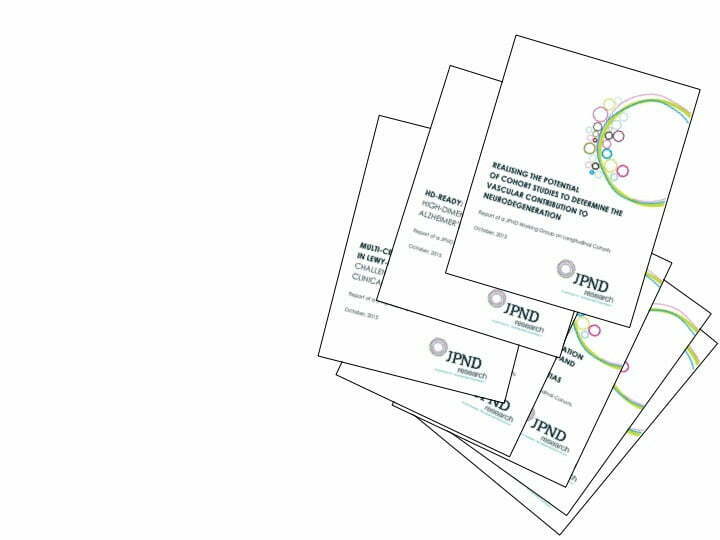
REPORTS AVAILABLE

JPND call 2014:  “ Working Groups to Inform Cohort Studies in Neurodegenerative Disease Research


Increasing the impact of longitudinal population studies for neurodegenerative disease research

The use of population studies offers a significant opportunity for research into factors affecting risk and progression of neurodegenerative disease, an opportunity that is greater than ever given the emergence of new molecular and digital technologies. However, to fully realise this potential there is a need to harmonise approaches and encourage collaboration and data sharing. In response to this, JPND commissioned ten groups of experts through a peer reviewed call for proposals to address methodological challenges preventing current population- and disease-based longitudinal cohorts being fully used for ND research.  A brief description of the valuable reports and recommendations provided by each group is provided below.

Philippe Amouyel, the Chair of JPND comments:

JPND recognises that longitudinal cohort studies are a rich but under-used resource. This is why we designed a rapid-action call to ask leading international experts to put their heads together to help exploit this opportunity and make population studies more accessible to a wider range of researchers. The guidelines that have been provided through this extensive body of work provide an important resource for the scientific community, which will help researchers increase collaborative activity and make productive use of longitudinal cohort studies. 

Reports available here

Slide3

The topics for the 5th IMI-2 Call are confirmed and the call is open

The topics for the 5th Call under the Innovative Medicines Initiative 2 are now confirmed, with a heavy emphasis on Alzheimer’s Disease (AD). The following four AD-related topics are included in the call:

– Inflammation and Alzheimer’s disease (AD): modulating microglia function – focussing on TREM2 and CD33

– Understanding the role of amyloid biomarkers in the current and future diagnosis and management of patients across the spectrum of cognitive impairment (from pre-dementia to dementia)

– Evolving models of patient engagement and access for earlier identification of Alzheimer’s disease: phased expansion study

– Apolipoprotein E (ApoE) biology to validated Alzheimer’s disease targets

The call is now open for stage 1 proposals with a deadline of October 13th, 2015. More information is available at the links below:

Links:

Call overview: http://www.imi.europa.eu/content/imi-2-call-5-0

Stage 1 proposals: http://www.imi.europa.eu/content/stage-1-16

The COEN initiative has released its third call for proposals aiming to further catalyse collaborative research to drive a step change in neurodegeneration research.

The Network of Centres of Excellence in Neurodegeneration (COEN) initiative aims to build collaborative research activity in neurodegeneration research across borders, focusing on critical mass and excellence. COEN is aligned with JPND, although it operates as an independent entity.

The third COEN call for research proposals was recently launched by six of the eight COEN members and will provide funds for ‘Pathfinder’ grants for innovative research to underpin new approaches to therapeutic intervention.

As in previous COEN calls, applications will connect centres with a critical mass of resources and expertise to drive a step change in neurodegeneration research. The six agencies are contributing £4.0m to fund awards made under the call involving their national Centres of Excellence.

The remit of the call is broad in scope: projects may include studies to illuminate our understanding of neurodegenerative mechanisms, or create technological advances to support novel diagnostic or therapeutic approaches.

The call will be administered as for the previous COEN pathfinder call, with partners funding research in their own country. The list of awards made under the first two COEN calls is located here.

More information can be found at the COEN website at the link below.  Closing date for submissions is 4pm on the 5th of October 2015 (BST; GMT+1)

Link:      http://www.coen.org/call-for-proposals-2015.html

JPND members are helping to move forward G7 activities in dementia research.

Making better use of data and sharing it among the research community may accelerate neurodegenerative disease research, as it offers the promise of larger and wider datasets that enable new insights from both well-established and novel sources and types of data. Furthermore, moving beyond established medical data into big data offers the potential to tap into routinely collected data from both within and outside health systems.

In December 2013, the G8 Global Dementia Summit in London identified the better use of available data, resource sharing and researcher collaboration as key priorities.  With the ambition to find a cure or disease-modifying therapy by 2025, the G8 health ministers mandated the OECD to report on how big data can be used and shared more efficiently for dementia research.

The results of the OECD review on big data were recently published and presented to the G7 health ministers at the first WHO Ministerial Conference on Global Action Against Dementia in Geneva in March 2015. This case-study review provides an evaluation of existing data sharing practices in research on age-related neurodegenerative diseases.  Four exemplar data sharing initiatives (ADNI, AddNeuroMed, UK Biobank and the Swedish Brain Power studies) were examined to better understand current data sharing practices in dementia research and to recommend the next steps required to move forward.

The OECD report was published under the advice of an International Advisory Group chaired by JPND Executive Board member Robin Buckle, with Philippe Amouyel (JPND Management Board Chair), Yves Joanette (JPND MB member, Canada) and Martin Rossor (Vice-Chair JPND SAB) also participating.

This follows the publication in February 2015 of an OECD compendium of current thinking in this area, bringing together a number of position papers on the use of big data in dementia research. These papers emanated from a workshop at the G7 legacy workshop in Ontario in 2014.

Finally, a wider description of this activity and the emerging big data and open science activities is described within the annual reports of both the World Dementia Council and the G7 Global Action against Dementia (GAAD), both published to coincide with the Geneva WHO Ministerial Conference.


Some of Europe’s brightest young leaders in research into dementia gathered in London on 27th February 2015 as part of a series of workshops to discuss innovative ideas to address the disease.

More than 50 young experts in fields such as neurology, psychiatry, cellular biology and sociology gathered for a series of discussions and workshops looking at how to help people with dementia live independently for longer and what needs to be done to find a cure. The experts were from 19 countries including the UK, The Netherlands, France, Sweden, Poland, Germany, Croatia, Slovenia and Belgium. Click here for a list of the Young Leaders who attended the workshop.

The workshop was hosted at the Foreign and Commonwealth Office by the UK Government’s Science and Innovation Network in partnership with the World Dementia Council and the Global Action Against Dementia programme, which were established after the UK Government hosted the 2013 G8 Summit on Dementia.

The young leaders were joined by members of the World Dementia Council, which was set up to provide global leadership on tackling the key dementia challenges. The event was also supported by the EU Joint Programming Initiative on Neurodegenerative Diseases (JPND) and Alzheimer Europe.

Flickr slideshow below courtesy of UK Foreign & Commonwealth Office, under Creative Commons licence.

This was the fourth in a series of workshops for young leaders organised by the Science and Innovation Network to support global efforts to achieve the 2013 G8 Summit Declaration commitments.  Previous Young Leaders workshops have taken place in the USA, Canada and Japan with the aim to create a global network of future young leaders which will continue to address the challenges presented by dementia.

The recommendations and outcomes of these workshops will be presented at the World Health Organisation’s First Ministerial conference on Dementia on March 16-17 in Geneva, Switzerland.  At the same time, the global Young Leaders Network will sign up to supporting future activities of the Global Action Against Dementia and the World Dementia Council.


Robin Grimes, FCO Chief Scientific Adviser said:
“International science and innovation collaboration is critical to deliver the commitment made at G8 to identify a cure or a disease-modifying therapy for dementia by 2025. This and other young leaders events will make a major contribution by bringing together the best young minds across a range of scientific backgrounds to encourage new ideas and foster new opportunities for innovation.”


Philippe Amouyel of the EU Joint Programme on Neurodegnerative Diseases said:
“The scale of the dementia challenge demands a global response, beyond G7 countries. This latest young leader workshop is importing new perspectives and innovative ideas from all over Europe and beyond to tackle the dementia challenge. By harnessing the collective brains of these ambassadors of research we ensure the future of dementia research remains bright, efficient and globalised”.


Working in association with the meeting organisers and Alzheimer Europe, JPND member countries actively identified and partly-supported the participation of Young Leaders in the workshop. Indeed, several JPND members increased their allocated support to facilitate the participation of as many identified young leaders as possible.  JPND Management Board chair, Professor Philippe Amouyel represented JPND in the workshop. Click here to view Philippe’s JPND presentation on the day.

The event was also covered by JPND on twitter via @P_Amouyel@JPNDeurope as well as from the @UKinFrance@matt_houlihan accounts. Keep up to date using the twitter hashtag #YLDementia.


On February 26th, 2015, Australia joined the ‘JPco-fuND’ call for proposals.

Due to this late arrival, researchers from Australia can participate as external collaborators in proposals submitted to this call under specific conditions.

The specific conditions for researchers in Australia can be found on the “Specific regulations” page of the call.

Should a proposal involving a collaborator from Australia be recommended for funding, these collaborators are eligible for funding from the NHMRC National Institute of Dementia Research (NNIDR).

*Please Note: Under this call the NNIDR will only fund research that focusses primarily on Alzheimer’s disease and other dementias.

The March 2015 editorial of The Lancet Neurology is entitled „Teaming up to fight neurodegenerative diseases„.

The editorial focuses on the recently-launched JPcofuND initiative.

To view the editorial, click here or on the link below.

The latest media articles on JPND (including previous Lancet Neurology editorials) are available here.


Image courtesy of The Lancet Neurology.

Since late 2014, a total of 25 JPND-supported transnational projects and working groups have begun their work to tackle the challenge of neurodegenerative diseases in a number of JPND priority areas.

JPND has now published user-friendly fact sheets of the individual projects and working groups which are supported under the following previously-launched JPND calls for research proposals.

The fact sheets are available on the particular call results page via the links above or through the „Supported Projects“ section of the JPND website.


On January 26th, 2015, Switzerland joined the recently-launched ‘JPco-fuND’ call for proposals.

Researchers from Switzerland are now able to participate as external collaborators in proposals submitted to this call under all three call topics.

Specific conditions will apply and can be found on the “Specific regulations” page of the call.

Should a proposal involving a collaboration with Switzerland be recommended for funding, this collaboration will be eligible for funding by the Swiss National Science Foundation.


The EU Joint Programme – Neurodegenerative Disease Research (JPND) in partnership with the European Commission has launched the ‘JPco-fuND’ call for proposals aimed at supporting transnational research collaborations in three JPND priority areas:

  • Longitudinal Cohort Approaches;
  • Advanced Experimental Models;
  • Risk and Protective Factors.

The call will see more than 30 million euro being made available by JPND member countries, with a 10 million euro European Commission “topping up” fund.

Neurodegenerative Diseases such as Alzheimer’s and Parkinson’s are a global health, economic and social emergency with numbers affected expected to double by 2030 and more than triple by 2050’ according to Professor Philippe Amouyel, Chair of the JPND Management Board. ‘With this in mind, JPND-participating countries have identified three further areas of greatest need for targeted investment in order to increase progress in the prevention and treatment of these diseases, as well as in patient care.

Professor Amouyel added ‘This call is launched as part of a major new cohesive action between JPND and the European Commission entitled JPco-fuND – the first concrete synergy between JPND and Horizon 2020 designed to address the global threat of neurodegenerative diseases’.

According to Professor Thomas Gasser, University of Tübingen and Chair of the JPND Scientific Advisory Board, ‘This call aims to pool the necessary expertise across Europe and globally to address these needs in the fight against neurodegenerative diseases. The call will support innovative, multi-disciplinary, collaborative research projects that will add value to the three research areas’.

The following neurodegenerative diseases are included for the three call topics outlined below:

  • Alzheimer’s disease and other dementias
  • Parkinson’s disease and PD‐related disorders
  • Prion diseases
  • Motor neurone diseases
  • Huntington’s disease
  • Spinocerebellar ataxia (SCA)
  • Spinal muscular atrophy (SMA)

Click here to link to the call for proposals webpage

Topic 1: Genetic, epigenetic and environmental risk and protective factors of neurodegenerative diseases

The aim of the first topic is to attract international teams of researchers who will explore the different processes at work in normal aging versus neurodegenerative aging and determine what role genetic and environmental factors can play. Factors such as family history, gender, stress levels, nutrition and others, can affect an individual’s risk, and provide protection from, or even resilience to, neurodegenerative diseases. However, it is likely that a combination of factors are involved, so a critical step will be to establish the relationship between genetic, epigenetic, environmental and social factors and their relative importance in order to identify those factors that can be changed or modified. This topic is a re-launch of the 2012 JPND call in this priority area. Details of the currently-supported JPND projects in this area are available here on the JPND website.

JPND countries participating in this topic (18) Austria, Belgium, Canada, Denmark, Finland, France, Germany, Israel, Italy, Luxembourg, The Netherlands, Norway, Portugal, Slovak Republic, Spain, Sweden, Turkey, United Kingdom

Topic 2: Longitudinal cohort approaches in neurodegenerative diseases

The goal of this topic is to further scientific progress at a transnational level by enhancing the capabilities of existing cohort studies, or by linking related cohort studies in a synergistic way. This may include bringing together well-characterised relevant cohort groups to harmonize, or make accessible, data to promote secondary analysis; adding new measurements, sample collections or data sweeps that add significant value or provide linkage to other studies; establishing novel assessment measures, taking advantage of new technologies, extending beyond the cognitive domain (i.e. motor and perceptual function) that can be applied to the broad spectrum of neurodegenerative diseases; delivering methodological developments or enhancements to establish cohorts as intervention platforms.

JPND countries participating in this topic (19) Austria, Belgium, Canada, Denmark, Finland, France, Germany, Israel, Italy, Luxembourg, The Netherlands, Norway, Poland, Portugal, Romania, Spain, Sweden, Turkey, United Kingdom

Topic 3: Advanced animal or cell experimental models of neurodegenerative diseases This topic aims to support the creation of experimental models that are more predictive of neurodegenerative diseases. This is a key barrier to progress in research as most of the current models are unable to take into account the multiple genetic and environmental factors that lead to the development of these diseases. However, in order to reproduce the complexity of these diseases there is a need for consensus in validating the platforms to be provided, which can only be achieved through a multidisciplinary approach that encompasses the best teams in a collaborative effort at a transnational level. Therefore, this topic encourages the implementation of a next generation of reliable and well characterized animal and cell models for neurodegenerative diseases. This may include the development of novel animal models for specific diseases to better reproduce the complexity of the clinical features of the disease in humans, the enhancement of existing animal models, e.g., by fostering a deeper characterization of the phenotypes and pathologies, and the exploitation of novel or the improvement of existing neuronal, neuronal-like cells or inducible pluripotent stem (iPS) cells, generated from different sources.

JPND countries participating in this topic (18) Austria, Belgium, Denmark, Finland, France, Germany, Israel, Italy, Luxembourg, The Netherlands, Norway, Poland, Portugal, Romania, Slovak Republic, Spain, Sweden, Turkey

Note 1: The call has a two-step procedure, with a first stage (pre-proposal submission) deadline of 23:59h C.E.T. on March 10th 2015.

Note 2: Proposals may cover more than one of the topics specified above, as long as the relevant work is carried out in a country that will financially support the topic. The balance of awards between the three topics will be decided by the Peer Review Panel and will depend on the quality of the applications. More information on the participating countries in each topic, in addition to specific grant practicalities is available on the call for proposals page here.

Note 3: Call applicants are encouraged to take advantage of the JPND online partnering tool to showcase their research group’s expertise, search for appropriate partners and pitch call-related ideas. An improved, multi-lingual version of the pilot tool is available on the JPND website here.

Note 4: This project has received funding from the European Union’s Horizon 2020 research and innovation programme under Grant Agreement No. 643417 – JPcofuND.